
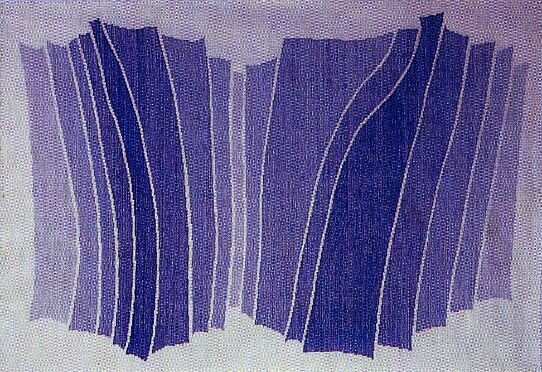
Theo Moorman, Woven Hanging, c. 1975. Courtesy of https://www.theomoormantrust.org.uk/
I’ve got a few fiber related resources on my mind this month. First, from the guild library, the book Weaving As An Art Form by Theo Moorman, 1975. I am a more recent weaver, and Moorman (or Dame Theo as she was known in the UK) had not been on my radar prior to this. I was fascinated to learn about her work and charmed by her style of writing. Her design process starts with a close observation of the natural world which she loosely sketches and then simplifies.
Moorman went to school for weaving in the 1920’s (well before the invention of “wall hangings”) and was trained to make utilitarian cloth. She developed her own style that was neither yardage nor in the mode of representational European tapestry. We are now accustomed to seeing weaving as modern art; Moorman was a trailblazer of this idea. She also developed the “Moorman Technique”, a method of inlaying weft yarn using a tie down system of warp yarns. There are YouTube videos that explain this technique for the modern weaver. I created a Pinterest board of her work here:
Next, I have a clip from the PBS show Craft In America, Season 13, Episode 1. This segment is 17 minutes into the episode (the first part of the show, while not fiber related, is also super interesting). The attached link explores a poetic figural weaver named Deidrick Brackens. He takes his mastery of technique and uses is to create thought provoking modern narratives. I enjoyed hearing him try to explain the joy of weaving. Brackens says of his time at the loom, “I fall into it… It’s like time travel” I can relate and I bet you can, too.
Third, here’s a podcast you might enjoy from The Art Angle called How Textiles Took Over the Art World. It is an interview with Elissa Auther who wrote a book called String Felt, Thread: The Hierarchy of Art and Craft in America. Auther is a curator at the Museum of Arts and Design in New York. I thought she had an interesting and very modern take on the old art/craft divide. I had to overlook the interviewer’s inexplicable habit of pronouncing tapestry “TAPEestry” but otherwise I thought it was a really thought provoking exploration of fiber as art.
Happy weaving and happy reading/listening,
Dina
 Gainesville Handweavers' Guild